Humidity is one of those things that new growers underestimate until it causes problems. Too high during flowering and you get bud rot. Too low during seedling stage and your young plants dry out and stunt. Getting humidity right is not complicated, but it does require understanding what levels your plants need at each stage and having the right equipment to maintain them.
Ideal Humidity Levels by Growth Stage
Cannabis wants different humidity levels depending on its age:
- Seedling stage (weeks 1 to 3): 65 to 70% relative humidity.
Seedlings absorb a lot of water through their leaves because the root system is not established yet. High humidity reduces the demand on those tiny roots.
- Vegetative stage (weeks 3 to 8): 50 to 65% relative humidity. As the root system develops, the plant relies more on root uptake and less on leaf absorption. You can gradually lower humidity through veg.
- Early flowering (weeks 8 to 12): 45 to 55% relative humidity.
Lower humidity encourages the plant to produce more resin (trichomes), which is what you want. It also reduces the risk of mold.
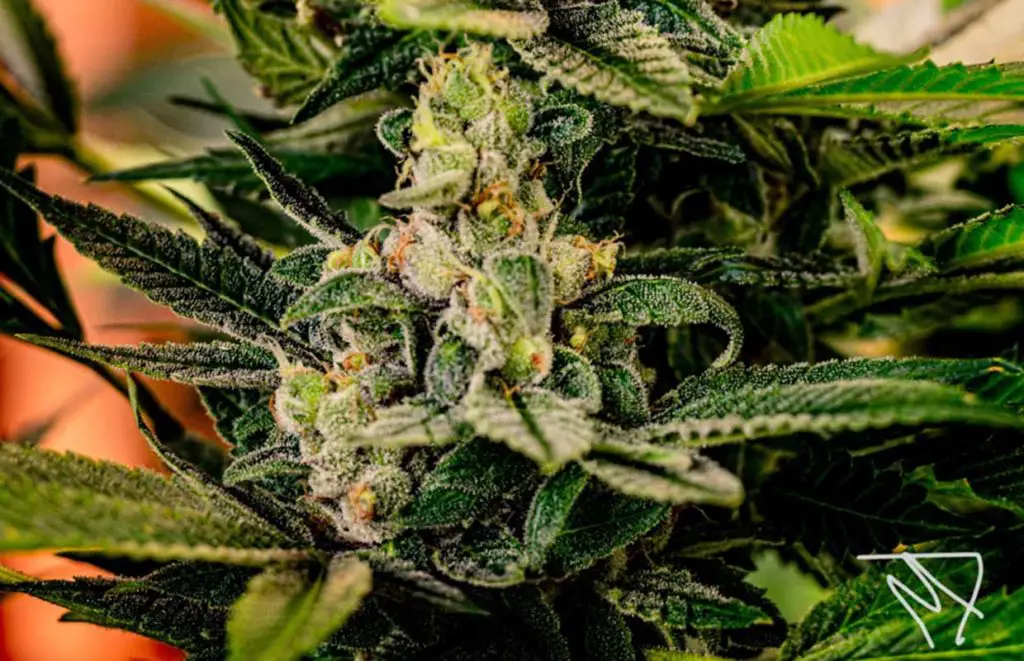
- Late flowering (last 2 to 3 weeks): 35 to 45% relative humidity. Dense buds packed tightly together are the perfect environment for botrytis (bud rot) if humidity is too high. Keep it as low as practically possible without stressing the plant.
Measuring Humidity Accurately
Get a digital hygrometer and put it at canopy level, not on the wall of your tent or across the room.
Humidity varies significantly even within a small grow space. The reading at canopy level is what your plants actually experience.
Cheap hygrometers from hardware stores are often wildly inaccurate (some are off by 10% or more). Spend $15 to $25 on a decent one. The Govee H5075 or Inkbird IBS-TH2 are both accurate and have Bluetooth connectivity so you can check readings on your phone. Place at least two units in your grow space to catch variations.
Lowering Humidity
This is the more common problem, especially during flowering when plants are transpiring heavily in an enclosed tent.
Ventilation is your primary tool. An inline exhaust fan pulling air out of the tent and replacing it with drier air from the room is the first line of defense. Size your fan appropriately. For a 4x4 tent, a 6-inch inline fan rated at 400 to 450 CFM is standard.
AC Infinity Cloudline T6 is the go-to recommendation because it has a built-in temperature and humidity controller that adjusts fan speed automatically. Check Latest Price
Dehumidifiers work when ventilation alone is not enough. Small portable dehumidifiers (30 to 50 pint capacity) are sufficient for most home grow spaces. Place the dehumidifier outside the tent in the same room if space inside the tent is limited, and let the exhaust fan pull drier room air in.
A dehumidifier inside the tent adds heat, which can be a problem in warm environments.
Defoliation helps too. Removing excess fan leaves during flower improves airflow through the canopy and reduces the total surface area transpiring moisture into the air. Do not go overboard, but thinning out the interior of the plant (called lollipopping) makes a meaningful difference in canopy humidity.
Raising Humidity
This is usually only needed during the seedling stage or in very dry climates.
Humidity domes over seedlings are the simplest solution.
A clear plastic dome (or even a cut plastic bottle) placed over each seedling traps moisture and creates a mini greenhouse. Remove the dome for a few hours each day to allow fresh air exchange and prevent mold.
Humidifiers work for larger spaces. A cool mist humidifier placed inside or near the intake of your grow space raises ambient humidity effectively. Ultrasonic humidifiers are quieter than evaporative ones but can leave white mineral dust on everything if you use tap water.
Use distilled water or a humidifier with a built-in filter.
Slowing down your exhaust fan during seedling stage helps retain moisture in the tent. If your fan has a speed controller (the AC Infinity models do), dial it back during this phase.
VPD: The Advanced Approach
VPD (Vapor Pressure Deficit) is a more precise way to optimize your environment by relating temperature and humidity together. In simple terms, warmer air can hold more moisture, so the ideal humidity depends on your temperature. At 80 degrees Fahrenheit, 60% humidity is fine during veg. At 70 degrees, that same 60% might be too high.
A VPD chart tells you the ideal temperature-humidity pairing for each stage. For veg, aim for a VPD of 0.8 to 1.1 kPa. For flower, 1.0 to 1.4 kPa. You can find VPD calculators online that let you plug in your temperature and get the target humidity.
Do not overthink VPD as a beginner. If you stay within the humidity ranges listed above and keep temperatures between 70 and 82 degrees, you will be in a healthy VPD range without calculating anything.